
Project #1 - Forsyth Park Fountain
In the 1840s, William Brown Hodgson conceived the idea of setting aside ten acres of wooded land at this site for the development of Savannah’s first recreational park. The space was reserved for a public park in 1857 and was named after former Georgia governor John Forsyth.
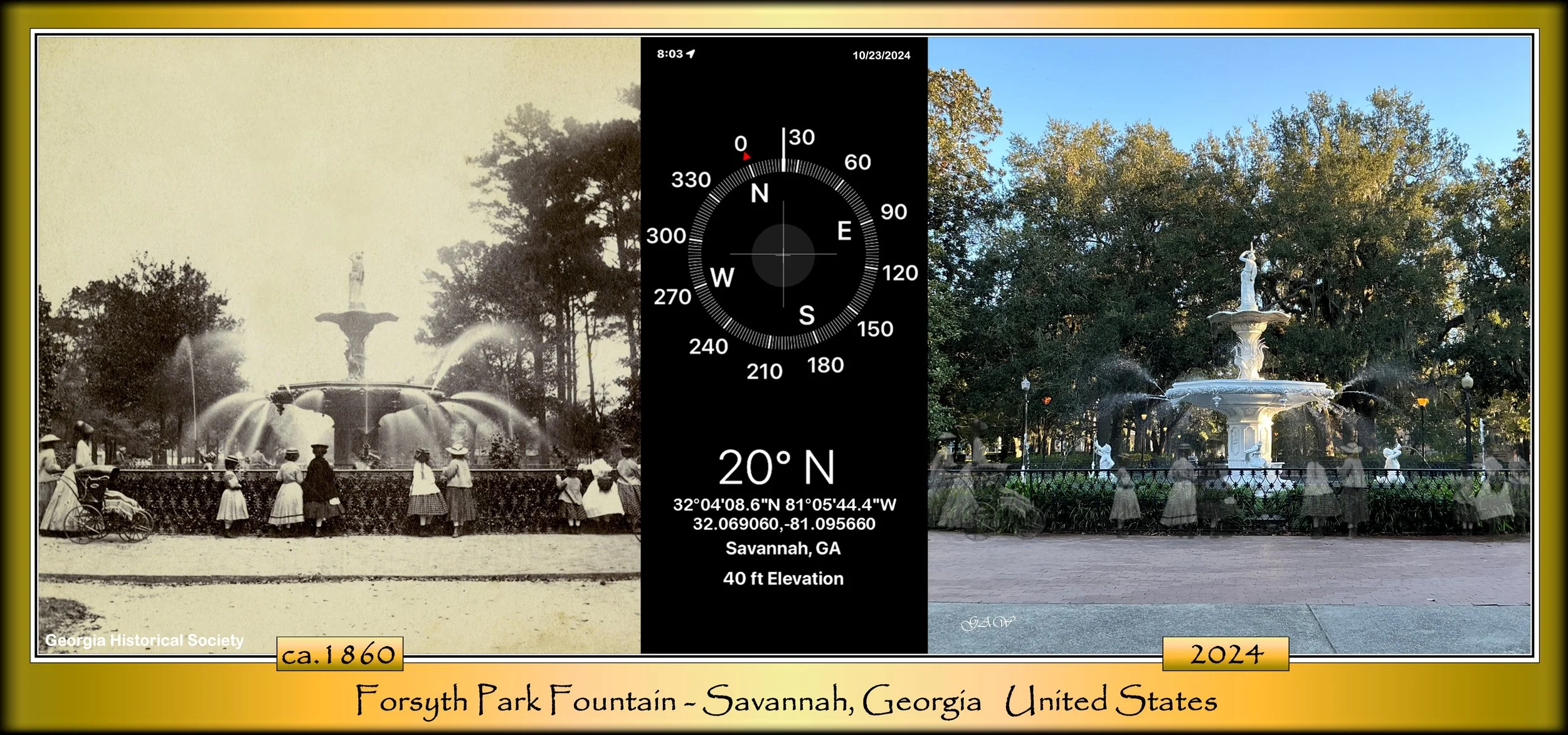
In 1858, the fountain was installed and radiating walkways were added. The fountain was originally built to provide clean drinking water to the citizens of Savannah, as yellow fever was a major epidemic in the city at that time.
In 1867, a 21-acre extension of the park was established as a military parade ground. In 1909, temporary training fortifications were constructed on the site and later used for military instruction during the First World War, reflecting the growing emphasis on preparedness in the early twentieth century.
Confederate soldiers used the area as a mustering ground during the Civil War, and later, in 1864, during Sherman’s March to the Sea (officially the Savannah Campaign), Union soldiers camped there after the surrender of Savannah.
The fountain was first constructed in 1858 and has undergone several modifications and repairs. Before 1973, the trumpeters did not all match: two held their trumpets with their left arms, while the other two used their right arms.
Unfortunately, three of the trumpeters were vandalized and destroyed. When they were recast, they were modeled after the remaining trumpeter. Today, all four match and hold their trumpets with their right arms.
The design of the fountain was modeled after a water feature in the Place de la Concorde and was based on a design from the J.P. Iron Foundry. It was manufactured by Janes, Beebe & Co. in Bronx County, New York, and was ordered from a catalog as Model No. 5.
It is estimated that several fountains of this design once existed around the world.
The fountain shares the park with two monuments:
a) In the center of the park stands a Civil War monument, appropriately located since many of the men it honors trained there before going to war. The monument was dedicated in 1874, and a bronze Confederate soldier was added in 1879 to honor those who fought for the Confederacy during the American Civil War.
b) At the south end of the park stands “The Georgia Volunteer,” a Hiker statue erected in 1931 to commemorate American soldiers who fought in the Spanish American War of 1898.
Fun Nuggets:
Just south of the fountain is the “Fragrant Garden for the Blind.” Solid cement walls were constructed around the garden to help contain and enhance the floral aromas. The names of the plants are displayed on plaques written in Braille.
This location has served as a filming site for several movies and television shows.
Movies shot in the park:
Road House 2 (2026)
Halloween Ends (2022)
The Underground Railroad (2020)
The Legend of Bagger Vance (2000)
Lady and the Tramp (2019)
Love Takes Flight (2019)
The Poison Rose (2019)
An LA Minute (2018)
Baywatch (2017)
Southern Charm Season 2 (2017)
The Divorce Party (2017)
Royal Pains (2013)
The Gingerbread Man (1998)
Midnight In the Garden of Good and Evil (1997)
Forrest Gump (1994)
The Judas Project (1988)
The Longest Yard (1974)
Cape Fear (1962)